Journey through our Solar System

Location: Children's Educational Center in Oradea, Romania
Oct. 8-th, 2010


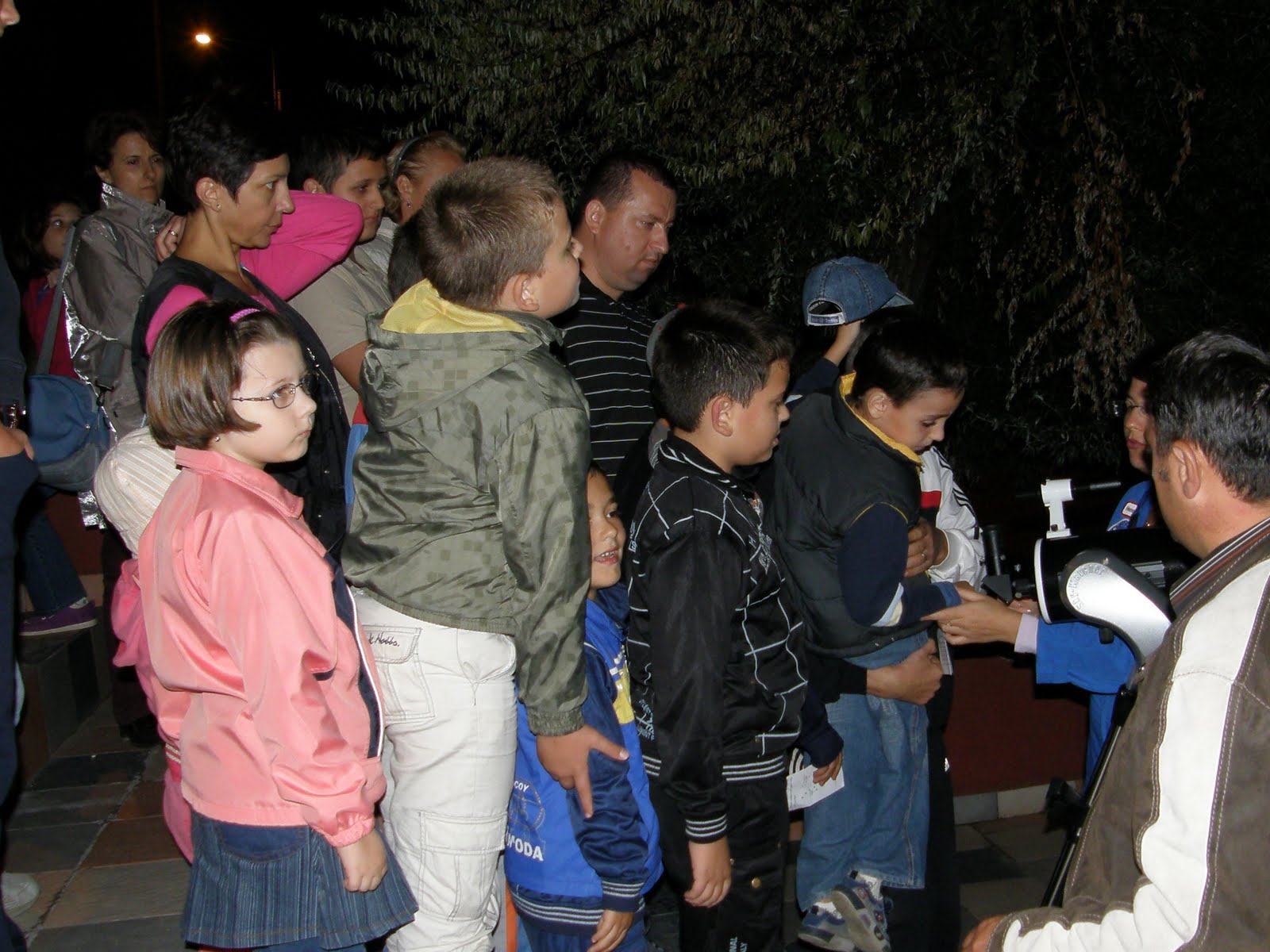
The little "astronauts" from Astronomy and Space Science Club of Oradea, were eager to participate in a space adventure: a journey through the planets and their satellites, during World Space Week.

After a relatively short journey to the Moon, followed by a lunar landing, the crew built a lunar basis, equipped with all necessary elements for human survival in this environment.

Two other teams have traveled to the red planet. Once the rovers arrived on Mars, participated in a competitive race. The laws of physics are the same on Mars: rovers propelled of air-filled balloons.
Finally, participants admired the spectacular images of the amazing Saturn, taken from Cassini spacecraft. They discovered some of the mysteries of the cosmos, with an unforgettable journey through our solar system.


Robots in space

Location: Dacia School Oradea, Romania
Oct. 8-th, 2010.

Robots in space
The outer space is fascinating, but the work and lives of the astronauts in this environment is not easy. Spatial robots are used to facilitate or even replace human work in space. Whether we talk about humanoid robots, autonomous and mobile explorers, all robots are built and programmed to perform a specific task.
Since the first spatial robot  (Sojourner, Robonaut), geologists robots exploring Mars (Spirit and Opportunity) to the robotic Canadarm2 on the International Space Station, which provides a work platform for astronauts, successfully meet all these different robots missions.

Journey through the Stars

Location: Children's Educational Center in Oradea, Romania
Time: September 2-nd, 2010

 
A journey through the stars with a spacecraft which travels with light speed led us into a dream outer space, but still real.
 
We admired stars, galaxies, and we just reached the edge of the known Universe. Here we saw quasars.
We returned safe to Earth and we admired the International Space Station which quickly passed over the night sky.


Mission: to the Moon

Location: Oradea Children's Town
Date: July 13, 2010

The Moon always inspired us to look to the sky. Since prehistoric times, all cultures around the world have looked to the moon, used it to measure time. What was this object change shape, disappear, and returning after each month as the queen of the night?

Was somehow the gods dwelling? Or even one day people will get to it?

This is the story of an epic journey, planned and carried through by people who are alive today: the story of Apollo missions.  The mankind have landed on the Moon 41 years ago.

1. Internal structure of the Moon
2.  The surface of the Moon
3. Mission accomplished: Apollo 11.


Comenius Course- School Robotics


Time: July 16-24, 2010
Location: Rethymno, Crete, Greece.

If you are a teacher from the EU, you may be eligible for Comenius programme. The  Comenius grant is to help cover course fees, travel to and from the country of study and subsistence costs. Contact your national agency for advice about what to do if you want to apply and to check your eligibility.
http://ec.europa.eu/education/lifelong-learning-programme/doc1208_en.htm
Although you can choose any teacher refresher course, the national agencies often prioritise courses that appear in the LLP course database:
http://ec.europa.eu/education/trainingdatabase .
I participated in July 16-24, 2010 in School Robotics, in Rethimo, Crete, Greece, a Comenius course. I received a grant from EU.

Check out this SlideShare Presentation:

The Sun

Location: Children's Educational Center in Oradea
Time: July 8-th, 2010

The Sun is the closest star to Earth and is the center of our solar system. A giant, spinning ball of very hot gas, the Sun is fueled by nuclear fusion reactions. The Sun is also an active star that displays sunspots, solar flares, erupting prominences, and coronal mass ejections. These phenomena impact our near-Earth space environment and determine our "space weather."
It is the largest object and contains approximately 98% of the total solar system mass. One hundred and nine Earths would be required to fit across the Sun's disk, and its interior could hold over 1.3 million Earths.

The light from the Sun heats our world and makes life possible.
1. The Sun's structure and composition
2. Biological effects of solar radiation
3. Wolf number-workshop.


Mars, the red planet

Location: The Children's Educational Center in Oradea, Romania
Time: June 24-th, 2010

Named after the Roman god of war the Red Planet has fascinated us more than any other planet.
A virtual journey to Mars (Mars with Google Earth) gave us a new possibility of studying the Martian landscape. We saw mountains, craters, .
Is there life on Mars? We studied the interesting photographs taken by satellites and the Mars Rover, Spirit and Opportunity.
Curiosity is the name of the third rover that NASA is preparing to launch it in 2011.


Save the blue planet!


Location: Children's Educational Center in Oradea, Romania
Time: June 10, 2010
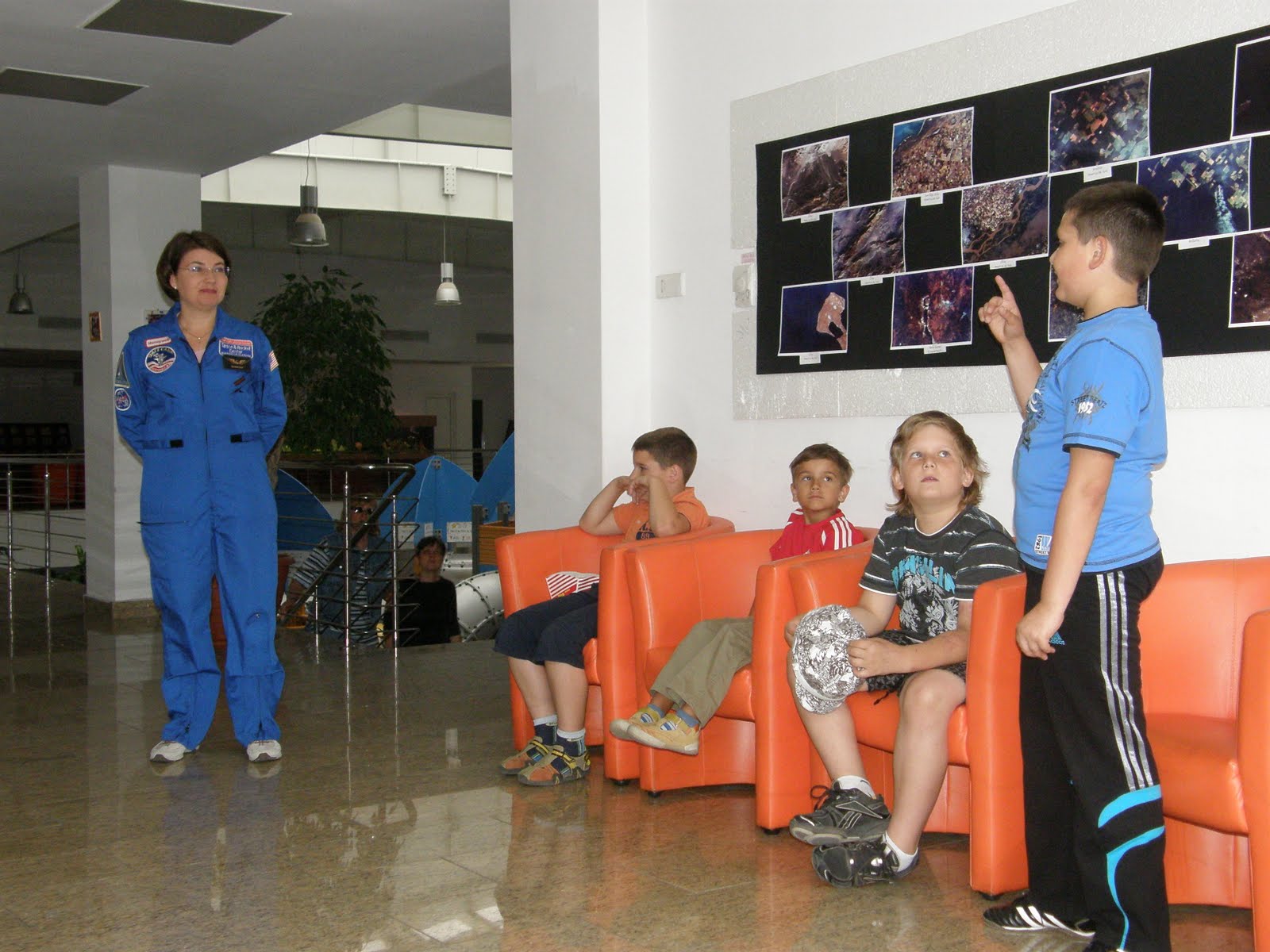
The pictures taken from ISS reveal our beatiful Earth.
Planet Earth was the subject of an exhibition of photography. The Earth is our home which offers all the elements necessary for our survival: water, air, food.
It is home to a diverse range of species and of the 6 billion people who live on the planet. Unfortunately, in recent years, man has adopted an attitude of negligence towards our planet. We have created an ecological imbalance own home, forgetting that our lives depend on how we take care and right to life of Earth.


My special invited Mrs. Anna Marossy talked about the danger of pollution in our life and other species.
Mrs. Adela Tuduce biologist at the Environmental Protection Agency talked about the International Year of Biodiversity, 2010.
Finally, we analized causes, effects and solutions for climate change.